Medical Science Vector Icons: A Designer's Practical Review
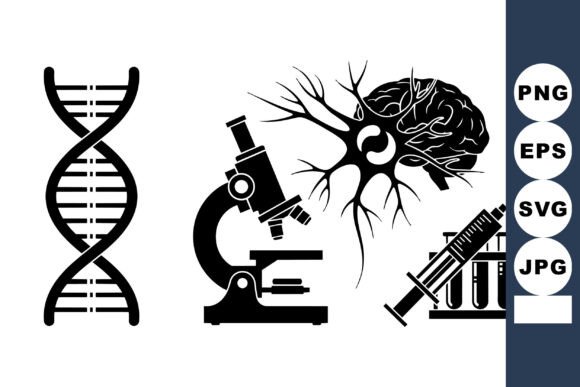
When a new embroidery design lands on my desktop, I immediately start picturing it stitched onto real fabric. That’s the lens I’m applying to the Medical Science Vector Icons collection. These bold, flat icons depicting a DNA double helix, a laboratory microscope, a neural brain cell, and a syringe with test tubes are simple in style, which in embroidery often means smart in execution. My first impression is clean, confident, and quietly professional. This isn’t a playful, whimsical set; it carries a mood of clarity and intelligence, which opens up some very interesting niches for handmade products.
The Immediate Fit: Where These Icons Belong
The visual personality here is straightforward and graphic. That makes these icons a natural candidate for projects where the theme needs to be communicated quickly and without fussy detail. I’m thinking immediately of custom apparel for science enthusiasts, lab technicians, medical students, or proud parents of a newborn doctor. A single icon embroidered on the chest of a premium sweatshirt or the corner of a tote bag used for carrying books and lab gear would look sharp. The simplicity also lends itself beautifully to baby items—a tiny, clean microscope or DNA helix on a knit blanket for a child born into a science-focused family feels like a modern, personalized gift.
For small business owners, especially those running boutique shops or Etsy stores catering to academic or medical communities, this set is a ready-made design asset. You could create a series of embroidered patches for backpacks, a line of aprons for home science kits, or even crisp pillow covers for a study nook. The icons represent established concepts, so recognition is high, which builds customer trust in your product’s messaging.
Stitching It Into Reality: Performance on Actual Projects
In real-life embroidery situations, a design’s simplicity is its greatest ally or a hidden challenge. For these vector icons, the lack of intricate internal detail is a major advantage. On custom apparel like t-shirts and caps, especially on curved surfaces, a clean shape with defined edges will stitch out with clarity. The bold outlines suggest they’ll translate well into satin stitches for borders and fill stitches for the larger solid areas, like the test tubes or the brain cell body. I can see these working nicely on a dense fabric like denim for a tote bag or on a smooth cotton twill for an apron.
For crafters thinking about holiday gifts or wedding gifts for a couple in the medical field, an embroidered kitchen towel or a set of pillow covers with these icons could be a uniquely thoughtful product. The design’s professionalism enhances the giftability, making it feel considered rather than generic. In a small shop merchandise context, using these icons consistently across products—say, on tea towels, patches, and baby clothes—can create strong brand consistency for a craft business focused on science-themed goods.
Where to Exercise a Bit of Caution
Even with clean designs, practical judgment is key. The syringe icon, with its slender lines and the small test tubes, requires attention on smaller hoop sizes. Stitching it very small on a cap’s curved front or on a delicate baby garment might risk losing the definition of the thinner elements. Similarly, on textured fabrics like some blankets or on stretchy fabric without proper stabilizer, those fine lines could become wavy.
Dark fabric backgrounds are a classic consideration. While the icons are bold, choosing thread colors with high contrast against dark materials is crucial to maintain that visual punch. I’d also look closely at the corners and any potential dense stitch areas in the design—like the center of the microscope or the helix—to ensure the stitch density is suitable for the fabric weight you’re using. Products destined for frequent washing, like apparel or kitchen linens, benefit from a robust stitch structure, so testing on scrap fabric first is non-negotiable.
Beyond the Stitches: Impact on Appeal and Value
How does this embroidery file affect the final product’s value? For embroidery designers and apparel decorators, a clear, well-executed icon set like this elevates the handmade presentation. It looks intentional and precise, which buyers associate with quality. For digital product sellers offering printable mockups or using the design as part of a broader commercial embroidery project, the clean vectors promise a good outcome, boosting buyer engagement in listings.
The theme itself taps into a passionate community. A neural brain cell icon on a sweatshirt isn’t just decoration; it’s a statement. That connection can transform a simple embroidered item into a cherished piece for the end user, whether it’s for personal use or as a small shop product sold at a craft fair.
A Designer’s Practical Notes Before Hooping Up
My workflow always includes a few checks before committing a design to a client project or my own merchandise. For the Medical Science Vector Icons, here’s what I’d do:
- Test the design on a scrap of the intended fabric—both a light and a dark version if possible—to judge thread color contrast and how the shapes settle on that texture.
- Review the stitch density in the embroidery file preview, if available, to see if any areas might be too dense for lightweight fabrics.
- Confirm the hoop size needed for the desired final size. Since specifics aren’t provided here, I’d run a test to see how small I can go before details like the test tubes or syringe needle start to blur.
- Inspect the small details, like the lines in the DNA helix or the microscope stand, in a black and white mockup. This helps plan for potential stitch type choices.
- Use proper stabilizer for the project fabric; these icons need a stable base to keep their clean edges.
- Most critically, check the licensing terms for the digital embroidery file. Before selling finished items or using it in commercial embroidery, confirm it’s cleared for that use. This is a fundamental step for any creative entrepreneur.
This set, categorized under Crafts and Graphics, feels like a specialized tool. It’s not for every project, but for the right project—a custom embroidered lab coat patch, a brain cell motif on a scholar’s blanket, a clean microscope on a boutique tea towel—it can be exceptionally effective. It’s a design that asks you to think about its context, and that’s often where the best, most resonant embroidery projects are born.